
This post may contain affiliate links, If you choose to buy through these links, I may receive a small commission at no additional cost to you.
Some life changes do not begin with dramatic decisions.
Instead, they begin with small habits that slowly reshape each day.
You can also explore our Easy Vegetables to Grow at Home for Beginners guide to build simple daily routines through gardening.
A few years ago, my routine looked normal from the outside.
Work was getting done. Responsibilities were handled.
Nothing seemed wrong. Yet the days felt rushed, crowded, and forgettable.
Soon, I noticed something important. I was busy all day, but I was not fully present in my own life.
Because of this, I tried a simple experiment – a 30-day life reset. I did not attempt to change everything at once.
Instead, I adjusted a few daily habits at a time.
The results were not dramatic overnight. However, within a few weeks, mornings felt calmer and evenings felt lighter.
Everyday life slowly became easier to manage.
This plan is not about perfection.
Instead, it focuses on small changes that gradually restore rhythm to daily living.
This 30 day life reset plan focuses on simple habits that gradually improve everyday living.
1. Week One – Reset Your Physical Environment

The 30 day life reset plan begins by improving your physical environment.
Many people try to reset their life by starting with motivation.
However, a simpler starting point is the physical environment.
When your surroundings feel calmer, your mind usually follows.
During the first seven days, focus on small visible improvements.
Clear one surface each day – a desk, bedside table, or kitchen counter.
Remove items you no longer use.
Open windows for natural light whenever possible.
Add one calming element such as a plant, simple lamp, or neutral fabric.
Adding a small desk plant such as the Bigreen Succulent Indoor Plant with Pot can instantly make your space feel calmer and more refreshing.
If you enjoy simple decor improvements, read our Minimal Home Decor Ideas for a Calm and Clutter-Free Space article for more inspiration.
These actions take only 15–20 minutes. Yet they signal the brain that something new is beginning.
By the end of the week, do not aim for a perfectly organized home.
Instead, aim for a space that feels easier to live in.
2. Week Two – Reset Your Daily Rhythm

Most stress does not come from large responsibilities.
Instead, it often comes from small daily chaos – irregular sleep, rushed mornings, and unpredictable evenings.
Week two focuses on building two anchor habits.
First, create a morning anchor. Spend ten minutes on a simple routine before checking your phone.
Stretching, journaling, watering plants, or quiet tea time all work well.
Next, create an evening anchor. A short activity that signals the end of the day is enough.
Reading a few pages, planning tomorrow’s top three tasks, or dimming lights earlier are helpful choices.
These anchors stabilize the day. As a result, productivity often improves once daily rhythm becomes predictable.
3. Week Three – Reset Your Mental Load

Many days feel exhausting not because of hard work, but because of mental clutter.
Unfinished thoughts, small worries, and scattered reminders slowly build pressure.
During week three, introduce two simple practices.
Write a daily brain-dump for five minutes.
A simple habit journal like the Zaslan Weekly Planner with Habit Tracker can make daily reflection easier and more consistent.
Follow the Rule of Three and choose only three priority tasks each day.
Completing them creates a clear sense of progress.
Because of this method, life begins to feel less overwhelming even though responsibilities remain the same.
4. Week Four – Reset Your Lifestyle Energy

By the final week, the environment feels calmer, routines feel stable, and mental clutter becomes lighter.
Now comes the deeper reset – energy habits.
Focus on three small lifestyle adjustments.
Build a movement habit such as a 15-minute daily walk or light stretching.
Create digital boundaries and spend one hour each day without screens or notifications.
Add a personal joy activity such as reading, gardening, sketching, or music.
You may also like our Sustainable Lifestyle Tips for Everyday Living guide to maintain long-term balance.
Together, these small actions gradually rebuild balance.
5. Tracking Your 30-Day Reset Progress
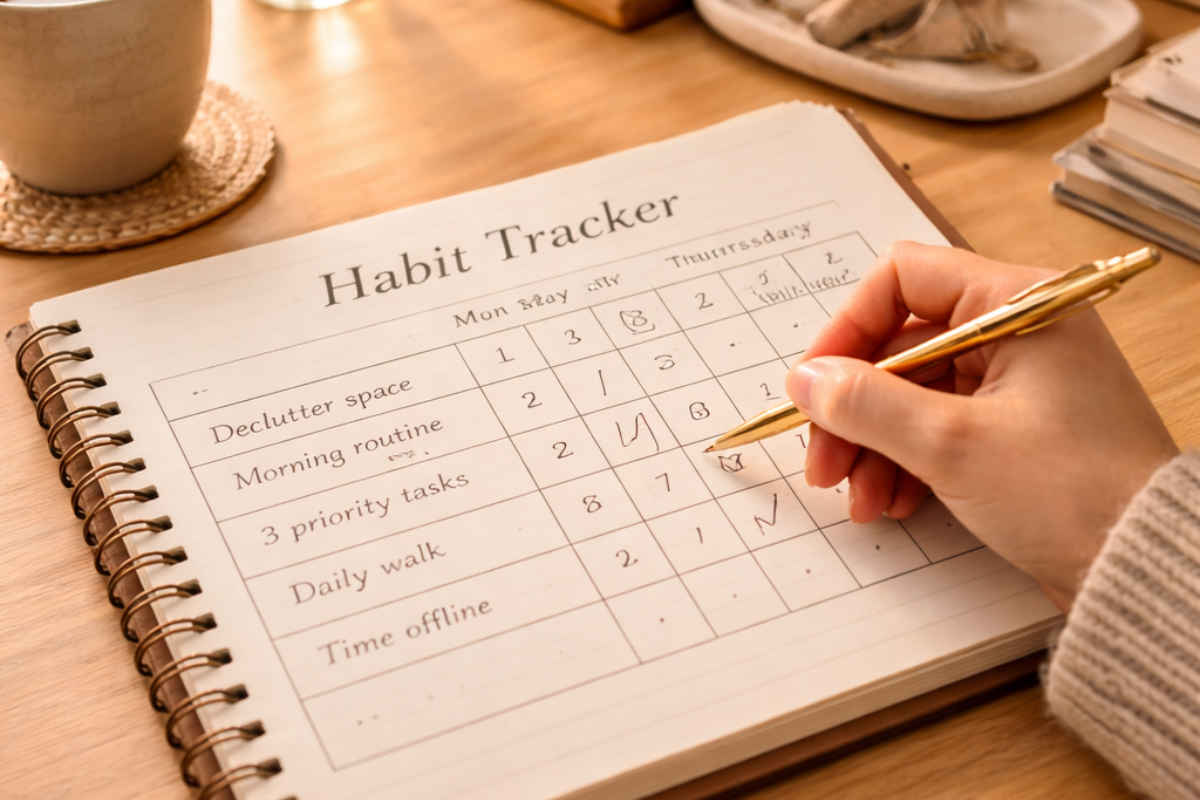
Tracking progress helps maintain motivation because visible progress encourages consistency.
A simple checklist or calendar works well for this purpose.
At the end of each day, mark the habits you completed.
Cleared a small space.
Followed morning anchor.
Completed three priority tasks.
Practiced daily movement.
Spent time offline.
Watching the checklist gradually fill creates a strong sense of achievement.
More importantly, it shows that meaningful lifestyle changes are happening even when they feel small.
6. When Small Daily Actions Begin to Reshape Everyday Life

By the end of this 30 day life reset plan, many people notice calmer routines and better daily focus.
Life rarely becomes overwhelming in one single moment.
Instead, it slowly fills with responsibilities, noise, digital distractions, and mental pressure.
Positive change happens in the same gradual way.
Research from the World Health Organization also highlights how consistent daily habits support long-term mental well-being and stress reduction.
Small actions repeated daily shape routines, and routines shape the direction of everyday life.
Thirty days from now, the outside of life may look almost the same.
Yet inside your daily rhythm – in how mornings begin, how evenings slow down, and how your mind feels at the end of the day — the difference will be clearly noticeable.
And very often, that is how meaningful change truly begins.