
This post may contain affiliate links, If you choose to buy through these links, I may receive a small commission at no additional cost to you.
Ever sit at your desk at 2:00 PM, stare at a completely normal email, and realize your mind feels like wet concrete?
Naturally, you assume you did something wrong. You did not skip sleep, and you carefully drank enough water throughout the morning. In fact, you even took the magnesium everyone on social media keeps raving about. Yet, your heart is beating with a persistent buzz of stress, your shoulders are practically touching your ears, and your train of thought derails every three minutes.
Most people blame burnout, digital fatigue, or sheer lack of discipline. However, cognitive neuroscientists have pinpointed a hidden trigger right under our noses: the physical geometry and sensory input of our work spaces.
Consequently, this is where adopting the neuro-architecture lifestyle changes everything.
The concept behind the neuro-architecture lifestyle is not some luxury design trend reserved for Silicon Valley campuses or Scandinavian penthouses. Instead, it is the practical study of how physical space reshapes brain chemistry, nervous system tone, and hormone production. Every single wall, shadow, ceiling height, and surface texture in your home constantly sends biological signals to your amygdala and prefrontal cortex.
Therefore, when your space unintentionally fights your brain, your adrenal glands dump excess cortisol into your bloodstream. This ongoing hormonal drain triggers persistent brain fog and shatters your attention span.
Fortunately, small and intentional spatial tweaks can flip that biological switch without requiring a contractor or a massive budget. By aligning your physical environment directly with your nervous system, you can slash baseline cortisol, clear cognitive fatigue, and unlock up to a 40% boost in daily deep work capacity.
What is Neuro-Architecture and Why Does It Control Your Stress?
Neuro-architecture fundamentally bridges neurobiology with interior spatial dynamics. Pioneered by neuroscientists like Fred Gage at the Salk Institute, clinical research published by the National Institutes of Health proves that physical surroundings directly prompt neurogenesis the birth of new brain cells or trigger chronic stress responses.
Specifically, your primitive brain evaluates physical spaces using ancient survival mechanisms:
Prospect and Refuge: Humans feel deeply at ease when our backs are protected and we have an unobstructed view of incoming threats.
Visual Compression: Tight spaces with heavy overhead fixtures signal confinement, which inevitably elevates blood pressure.
Sensory Overload: Flickering artificial bulbs and clashing synthetic patterns force your sensory cortex into continuous background processing.
Whenever your room violates these survival baselines, your body operates in a covert fight-or-flight state. As a direct result, your prefrontal cortex—the seat of executive function, creative synthesis, and emotional control—shuts down to conserve energy for basic survival vigilance.
Ultimately, building a consistent neuro-architecture lifestyle simply means tuning your surroundings so your brain feels safe enough to focus.
1. Flip Your Desk into the “Commanding Position”
Pause for a second and assess how your desk is actually set up. For instance, is your desk pressed flat against a blank wall, forcing your back toward an open door or a busy hallway?
If so, you are triggering what neurobiologists call a startle response penalty.
Because your back remains exposed to an open doorway, your primitive brain cannot fully relax. Instead, it keeps a micro-thread of subconscious attention running constantly to monitor auditory cues and peripheral motion behind you. Consequently, this hidden vigilance keeps baseline cortisol elevated throughout the entire workday.
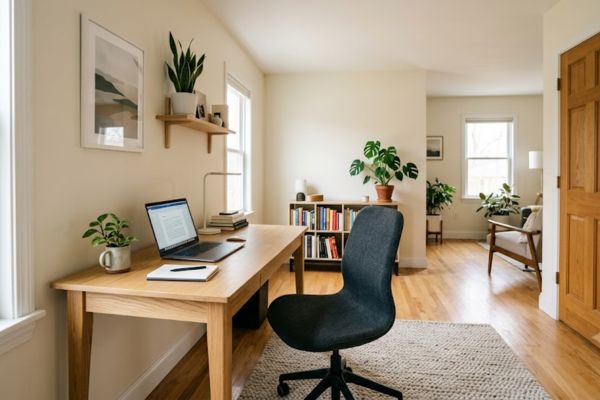
The Fix:
First, pull your desk away from the wall and angle it so your back rests against a solid surface, giving you a clear sightline toward the room’s entrance.
Alternatively, if your room layout is too small to flip the desk, place a clean convex mirror on your monitor or shelf so your peripheral vision catches anyone walking in.
As an immediate result, your amygdala powers down vigilance routines, liberating vital mental bandwidth for uninterrupted deep work.
2. Eliminate Visual Micro-Friction to End Cognitive Fatigue
Brain fog is rarely a lack of mental stamina; rather, it is almost always sensory exhaustion caused by visual micro-friction.
Every single object sitting on your desk demands what cognitive researchers term “attentional saccades.” Even if you are not consciously looking at a tangled charging cord, a stack of unread letters, or an empty mug, your visual cortex continuously processes their edges and colors in the background.
Therefore, visual clutter in your direct field of view causes constant peripheral saccades, which quickly drains working memory and triggers severe 2 PM brain fog. Embracing a daily neuro-architecture lifestyle helps you eliminate these micro-distractions before they sap your cognitive reserve.
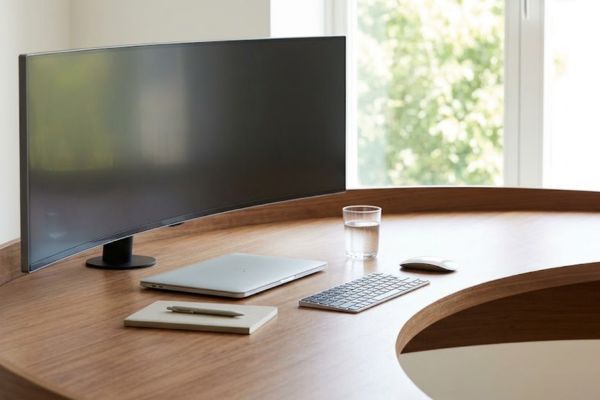
The Fix:
The 180-Degree Clean Horizon: Sit in your working chair and extend your arms in a 180-degree semi-circle. Next, ruthlessly clear everything inside this direct peripheral zone.
Keep only three essential items within arm’s reach: your primary input device (keyboard or laptop), your working notepad, and hydration.
In addition, store chargers, loose pens, and random papers in closed containers or deep drawers out of sight. Because your eyes can now scan forward without catching visual noise, your cognitive load drops sharply within 48 hours.
3. Calibrate Circadian Kelvin Gradients to Stop Cortisol Spikes
Most homes run on disastrous lighting choices. For example, many people sit under harsh 6500K blue-white overhead lighting at 8:00 PM, while others work under dim, yellowish 2700K incandescent bulbs at 10:00 AM while fighting to stay awake.
Different light wavelengths directly regulate the suprachiasmatic nucleus, the central nervous system’s internal master clock. A well-designed neuro-architecture lifestyle always synchronizes indoor color temperature with the natural path of the sun.
| Time of Day | Ideal Color Temperature (Kelvin) | Lux Level | Biological Target |
| 07:00 AM – 12:00 PM | 5000K – 6000K (Bright Cool White) | High (1000+ Lux) | Cortisol peak awakening response & rapid alertness |
| 12:00 PM – 05:00 PM | 3500K – 4500K (Neutral Daylight) | Moderate (500 Lux) | Steady sustained dopamine and working memory |
| 05:00 PM – 10:00 PM | 2200K – 2700K (Warm Amber) | Low (less than 150 Lux) | Cortisol clearance & natural melatonin secretion |
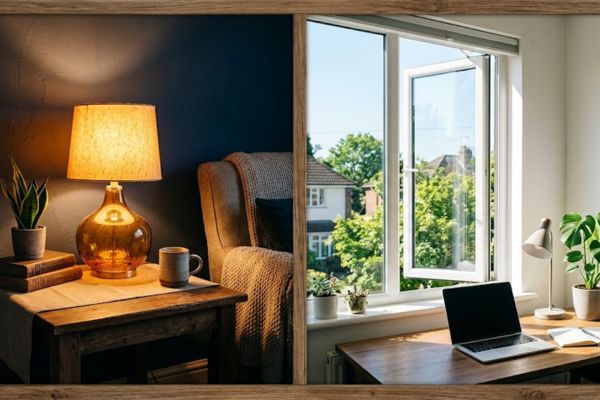
The Fix:
First, eliminate harsh overhead “big lights” after sunset and switch strictly to low-altitude lighting, such as warm lamps placed at waist level or on the floor. If you want a stylish way to add diffused evening glow without spending much, check out our guide on DIY fluted sconces and hidden LED backlighting hacks to build calm, indirect illumination.
Meanwhile, work right next to an open window during morning hours to absorb full-spectrum photons through your retinas.
Furthermore, if natural daylight is scarce, use full-spectrum daylight LED bulbs positioned directly at eye level during the first half of the day.
4. Leverage the “Cathedral Effect” for Focus vs. Creative Synthesis
In 2007, behavioral researcher Joan Meyers-Levy published a landmark discovery on ceiling height and human cognition:
High Ceilings (3+ Meters / 10+ Feet): These spaces visually signal spatial infinity. Thus, the brain naturally shifts into relational, abstract, and big-picture creative thinking.
Low Ceilings (2.4 Meters / 8 Feet or Below): These spaces trigger bounded, detail-focused processing. Consequently, the brain excels at linear, analytical tasks like coding, accounting, or precision editing.
Unfortunately, many professionals try to tackle grueling analytical work in vast open-plan spaces, or they attempt to brainstorm complex company strategies while boxed into cramped low-ceiling corners. In both scenarios, the spatial cues directly conflict with the mental objective. Practicing the neuro-architecture lifestyle teaches you to align ceiling cues with the exact mental tasks on your schedule.

The Fix:
For detailed analytical tasks: Sit under an angled desk task lamp or work in a smaller, dedicated room nook. Because the localized lighting cone mimics a lowered visual ceiling, it naturally narrows your mental focus.
For vision planning and ideation: Step away from your compact desk. Instead, work in a room with tall windows, step out onto an open balcony, or sit inside a high-ceiling library.
5. Build a Biophilic Sensory Shield with Living Geometries
Humans spent 99% of evolutionary history surrounded by organic, non-linear forms. Today, however, we spend nearly 90% of our lives inside sterile rectangular concrete boxes dominated by sharp 90-degree angles.
Neuroscience research shows that staring at relentless straight lines forces the brain to process spatial environments as artificial and alerting. Conversely, looking at natural geometric patterns—known as statistical fractals measurably reduces alpha-wave stress responses in the central nervous system.
While rectilinear geometry with sharp box walls drives subconscious vigilance, fractal patterns found in natural leaves and wood grain stimulate parasympathetic activation, thereby downregulating cortisol.

The Fix:
The 20-Minute Gaze Shift: Place a broad-leaf indoor plant (such as a Ficus elastica, Monstera, or ZZ Plant) precisely 45 degrees to the left or right of your primary monitor.
Every 20 minutes, look away from the digital screen and let your gaze rest on the plant’s natural fractal veins for 30 seconds.
Additionally, introduce natural tactile materials across your workspace, including solid wood tabletops, woven linen desk mats, or stone coasters. This natural tactile feedback actively dampens the sensory irritation caused by touching smooth plastic and cold aluminum all day long.
6. Neutralize Low-Frequency Environmental Acoustic Stress
You might assume you work comfortably in silence, but modern homes are rarely quiet. In reality, they hum constantly with low-frequency acoustic vibrations from refrigerator compressors, HVAC vents, highway traffic, and urban street noise.
Even when you consciously ignore them, your auditory cortex continues decoding these background frequencies. As clinical studies demonstrate, prolonged exposure to low-frequency background noise stimulates subtle epinephrine secretion, leading directly to afternoon mental fatigue and mood swings. A comprehensive neuro-architecture lifestyle proactively accounts for auditory damping alongside visual decor.
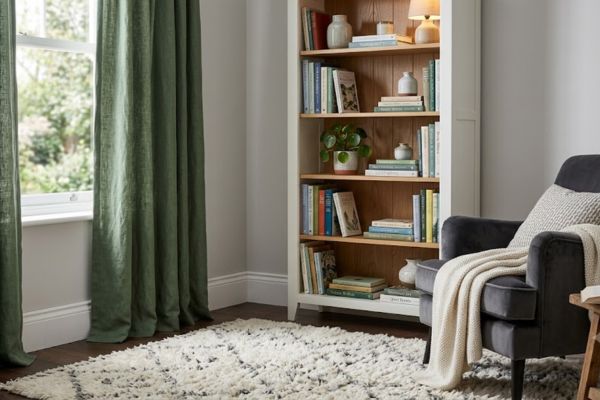
The Fix:
Acoustic Softening: Hard flat surfaces bounce acoustic waves like pinballs. Therefore, add high-pile rugs, heavy woven curtains, or open bookshelves loaded with uneven books to disperse acoustic flutter. If outdoor street rumble or neighborhood hum is your main issue, you can naturally baffle background decibels by building an acoustic green wall with sound-absorbing plants to quiet and cool your indoor space.
Broadband Sound Masking: Introduce non-looping pink or brown noise during intensive focus sprints. To drown out disruptive office chatter and low-frequency street rumble, running a mechanical ambient sound generator like the Yogasleep Dohm Classic original white noise sound machine creates a steady acoustic blanket that calms your nervous system and protects your focus.
7. Establish Strict Neuro-Spatial Anchors
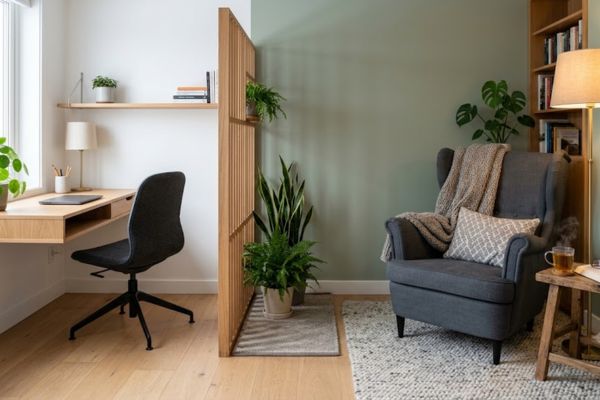
Your brain is fundamentally an associative prediction engine. Thus, if you sit in bed and scroll through work emails, your subconscious immediately associates your mattress with deadline anxiety. Similarly, if you watch movies on your laptop at your work desk, your brain registers that workspace as an entertainment zone.
Mixing functional associations in the same physical spot creates cognitive split-state fatigue. As an inevitable consequence, you will feel restless when trying to sleep and sluggish when trying to concentrate. Maintaining a mindful neuro-architecture lifestyle means anchoring distinct brain states to designated physical zones in your living quarters.
The Fix:
Clearly designate unambiguous physical anchors for specific neuro-states:
The Execution Anchor: One specific chair, dedicated strictly to deep analytical work without social media or streaming interruptions.
The Recharge Anchor: An armchair, balcony cushion, or living room sofa reserved solely for reading, journaling, and conversation.
The Sleep Sanctuary: Zero screens, no work documents, and blackout darkness.
Even in a compact studio apartment, you can easily create psychological micro-zones by altering sensory cues. For instance, simply change the desk lamp angle, put away the external keyboard, or swap your seating pad when shifting from work mode to relaxation.
Spatial Tweak Quick-Reference Checklist
| Spatial Tweak | Biological Mechanism | Time to Implement | Target Outcome |
| Commanding Position | Quiets subconscious startle reflex | 10 Minutes | Lower baseline cortisol |
| 180° Clean Horizon | Eliminates peripheral micro-saccades | 15 Minutes | Clears 2 PM brain fog |
| Circadian Kelvin Shift | Regulates suprachiasmatic nucleus | 5 Minutes | Sharp morning energy, easy sleep |
| Ceiling Height Cues | Engages the Cathedral Effect | Immediate | Sharp focus vs. creative flow |
| Biophilic Geometry | Fractal-induced parasympathetic tone | 10 Minutes | Drops nervous system agitation |
| Acoustic Dispersal | Absorbs low-frequency audio drag | 20 Minutes | Prevents afternoon sensory drain |
| Spatial Anchors | Strengthens context-dependent memory | Ongoing | Zero-friction task switching |
FAQ: Exercise, Movement, and Brain Health
Q1: What are the 10 key benefits of exercise on the brain?
Stimulates Neurogenesis: Triggers Brain-Derived Neurotrophic Factor (BDNF), helping create new brain cells.
Improves Memory Retention: Directly enlarges and protects the hippocampus, the core memory center.
Clears Brain Fog: Enhances cerebral blood circulation, delivering fresh oxygen and glucose to clear mental fatigue.
Sharpens Executive Function: Improves problem-solving, goal-setting, planning, and task switching.
Reduces Cortisol & Stress: Balances whole-body stress hormones while soothing an overactive amygdala.
Boosts Mood Regulators: Elevates serotonin, dopamine, and endorphin pathways to combat depressive symptoms.
Enhances Neuroplasticity: Strengthens neural connections, making it easier to acquire new knowledge.
Promotes Deeper Sleep: Enhances slow-wave deep sleep cycles critical for overnight memory consolidation.
Reduces Cognitive Decline: Protects neural architecture against age-related neurodegenerative diseases like dementia.
Sustains Focus & Attention: Boosts immediate blood flow to the prefrontal cortex, expanding your attention span.
Q2: How does exercise improve memory and cognitive function biologically? Exercise acts through three distinct biological pathways:
Molecular Signaling: Vigorous movement stimulates the liver, muscles, and bones to produce molecules (like lactate and irisin) that cross the blood-brain barrier and trigger BDNF production.
Vascular Angiogenesis: Cardiovascular workouts stimulate the growth of new microscopic blood vessels in the brain, improving nutrient and oxygen delivery.
Synaptic Plasticity: Regular movement strengthens the synaptic junctions between existing neurons, making pattern recall and memory retrieval faster and more resilient.
Q3: Does exercise really help clear brain fog?Yes. Brain fog is largely driven by neuroinflammation, poor cerebral circulation, and high baseline cortisol. Moderate-to-vigorous physical exercise immediately:
Increases cerebral blood flow to flush out metabolic waste.
Downregulates inflammatory cytokines that slow down neural signaling.
Triggers an immediate release of norepinephrine and dopamine, restoring alert, clean cognitive processing within 20 to 30 minutes.
Q4: Do I need an expensive lighting setup to protect my circadian rhythm?
Not at all. Keeping overhead ceiling lights turned off after sunset and using low-altitude warm lights is more than enough. Instead of rewiring your entire room, you can simply clip a budget-friendly source like the Hooga rechargeable amber blue light blocking reading light to your desk or headboard for gentle, melatonin-friendly 1600K illumination.